The Intelligence Economy: How Organizations Measure the True Value of Software Investments
Operational Intelligence and ROI: The Modern Framework for Software Investment Analysis


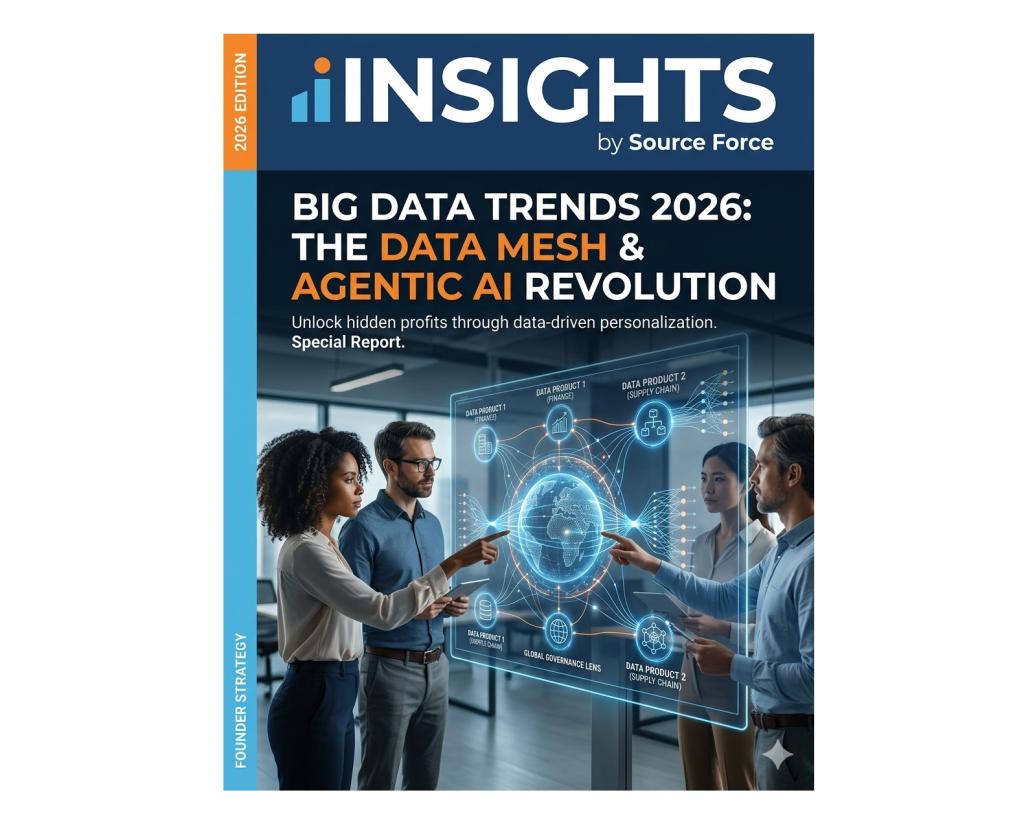
"A strategic report on the 2026-2030 Big Data outlook. Key topics include Agentic Analytics, Multimodal Embedding for Dark Data, and Zero-Knowledge Discovery. Essential reading for CEOs transitioning to agent-ready enterprise architectures."
From Massive Accumulation to Intelligent Action: Navigating the Era of Data Sovereignty and Agentic Analytics.
As we move through 2026, the "Big Data" conversation has matured. We are no longer obsessed with the mere volume of information the "V" for Volume has been eclipsed by the "V" for Velocity of Decision. In this specialized report for Insights by Source Force, we deconstruct the shifting tectonic plates of the global data economy, where data is no longer just "oil," but the very nervous system of the autonomous enterprise.
In 2026, the traditional "Data Lake" has been replaced by the Data Mesh. Organizations have realized that centralizing data creates bottlenecks. Instead, we see a decentralized architecture where data is treated as a product, owned by the specific business units that understand it best.
The most significant trend of 2026 is the integration of Agentic AI with Big Data stacks. We have moved from dashboards that show "what happened" to autonomous agents that "make it happen."
Self-Healing Pipelines: AI agents now monitor data quality in real-time, automatically correcting schema drifts and null values without human intervention.
Natural Language Discovery: The "Data Scientist" bottleneck has eased as executives use specialized LLMs to query petabytes of unstructured data using simple voice commands.
For years, 80% of enterprise data (videos, sensor logs, internal chats) was "dark" stored but never used. Breakthroughs in Multimodal Embedding have allowed companies to index and search this data, turning ignored archives into competitive goldmines.
The Big Data market is no longer a Silicon Valley monopoly. It is a multipolar battlefield of infrastructure and policy.
Entity Type | Key Players (2026) | Regional Strength |
|---|---|---|
Infrastructure Titans | Snowflake, Databricks, Microsoft (Azure Fabric), AWS | USA (Dominant in Cloud-Native) |
Sovereign Cloud Leaders | OVHcloud, Deutsche Telekom, Alibaba Cloud | EU & China (Data Privacy Focus) |
Agentic Frameworks | Palantir (AIP), LangChain, MongoDB | Global (Focus on Interoperability) |
Chip Architecture | NVIDIA, ARM, Groq | USA/UK (In-Memory Processing) |
Leading Countries:
USA: Remains the hub for venture capital and foundational model scaling.
European Union: Setting the global standard for Data Governance through the finalized AI Act and Data Act.
United Arab Emirates & Qatar: Emerging as the "World’s Data Vaults" due to massive investments in carbon-neutral, hyperscale data centers.
India: Leading in Data Labeling and Fine-Tuning at a massive scale for vertical AI models.
Edge Intelligence 2.0: Data is no longer sent to the cloud for processing. With ARM-based Edge Clusters, 60% of data processing now happens at the source (factories, vehicles, smart cities), reducing latency and egress costs.
Synthetic Data Generation: To bypass privacy hurdles, companies are using GANs (Generative Adversarial Networks) to create "Twin Data" statistically identical datasets that contain no real personal info, allowing for rapid R&D.
Quantum-Ready Encryption: As quantum computing nears, the "Harvest Now, Decrypt Later" risk has led to a surge in Post-Quantum Cryptography (PQC) for data at rest.
The Metadata Trap: As agents become more autonomous, the risk of "Agentic Hallucination"where an AI makes a massive procurement buy based on misinterpreted data is a primary board-level concern.
Regulatory Fragmentation: Navigating the different "Data Sovereignty" laws between the US, China, and the EU is becoming a significant operational tax on multinational corporations.
Energy Scarcity: The sheer compute power required for 2026-level analytics is hitting the limits of local power grids.
Monetizing the Mesh: Companies are beginning to sell "Data Products" directly to other AI agents through automated marketplaces, creating new, high-margin revenue streams.
Hyper-Personalization at Scale: Using real-time stream processing to change a user's digital experience every 500 milliseconds based on their current intent data.
By 2030, the term "Big Data" will likely disappear, replaced by "Ambient Intelligence."
2027-2028: We expect the full commercialization of Biological Data Storage, using DNA-based systems to store exabytes of data for centuries with zero power.
2029-2030: The transition to Zero-Knowledge Discovery, where AI can find insights across encrypted datasets without ever "seeing" the raw underlying information.
In 2026, the winners are not those with the most data, but those with the most Trustworthy Data. As we head toward 2030, the strategic imperative for every CEO is to transition from being a "Data-Driven" company to an "Agent-Ready" one. Your data must not only be clean; it must be actionable by the autonomous systems that will soon run the global economy.
The analyses and forecasts presented in this report are for informational purposes. While Insights by Source Force utilizes high-fidelity modeling, the Big Data sector is subject to rapid shifts in regulation and hardware availability. No Investment Advice: Content does not constitute financial or legal advice. Readers should perform independent due diligence before committing capital to specific technologies or infrastructure projects. AI Disclosure: This report was synthesized with the assistance of Agentic AI workflows and audited by our human editorial board.

Operational Intelligence and ROI: The Modern Framework for Software Investment Analysis
From public listings to strategic buyouts, this piece examines how investors align capital with exit opportunities balancing risk, timing, and return potential to maximize outcomes.
A definitive report for Insights by Source Force on the 1,600+ global unicorns. Detailed country-by-country analysis, future outlooks to 2030, and the impact of Agentic AI on startup valuations.