The Intelligence Economy: How Organizations Measure the True Value of Software Investments
Operational Intelligence and ROI: The Modern Framework for Software Investment Analysis

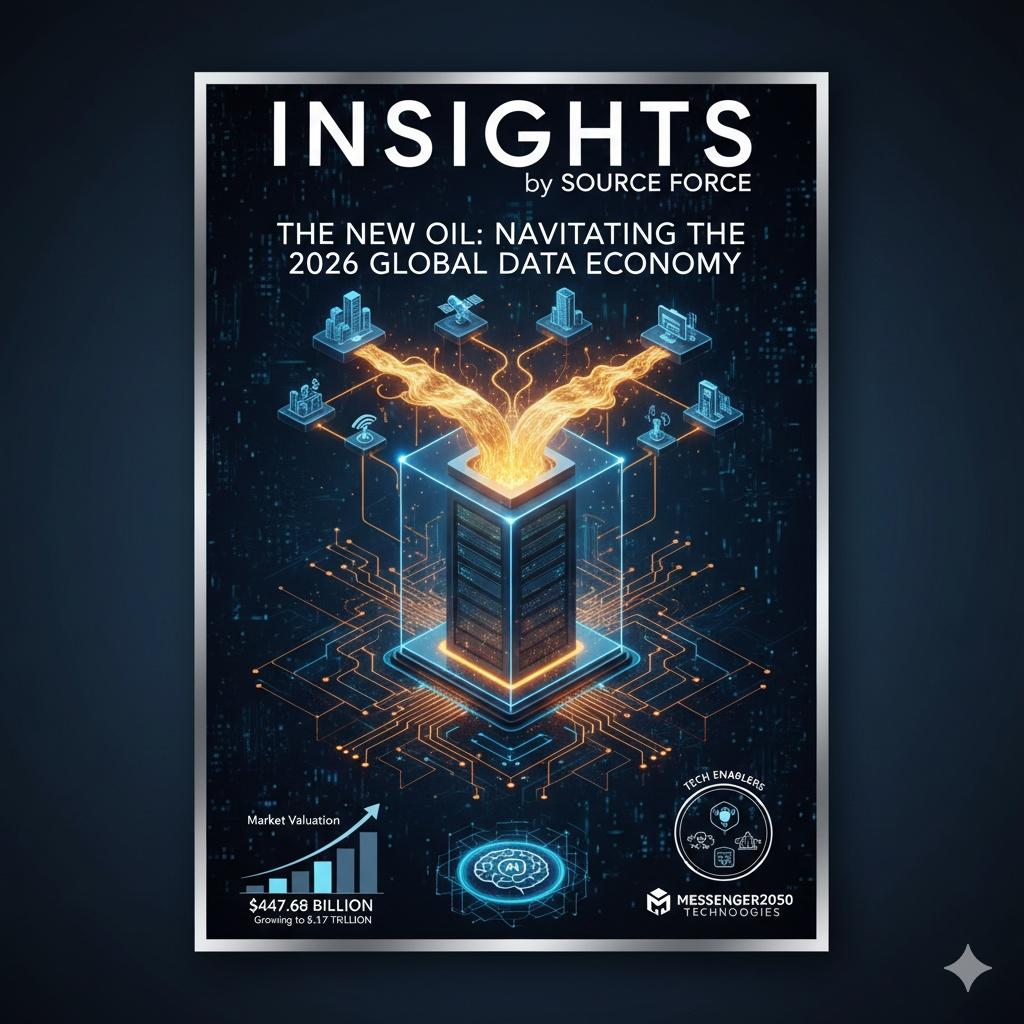
Explore the 2026 data economy's $447.68B landscape. From top server hubs to innovations, discover the future of global data.
Table of contents [Show]
Editorial Team: Insights by Source Force
In 2026, data has transcended its role as a "digital exhaust" to become the primary engine of global GDP. The Data Economy is no longer just about storage; it is a sophisticated ecosystem of creation, refinement, and monetization. As organizations pivot from data collection to real-time intelligence, the infrastructure supporting this the massive server stations and the tech providers like Messenger2050 Technologies have become the most valuable assets on the planet.
The Data Economy is a multi-layered industry encompassing Data Generation (IoT, Social Media), Infrastructure (Data Centers, Hardware), and Analytics (AI, Machine Learning).
The industry operates through a cyclical "Refinery Model":
The landscape is dominated by a mix of "Hyperscalers" and specialized technology providers.
Country | No. of Data Centers (Approx.) | Key Feature |
|---|---|---|
USA | 5,400+ | Leads in Hyperscale (Northern Virginia is the world capital). |
China | 1,800+ | Dominates in massive state-backed information parks. |
Germany | 500+ | The European hub for data privacy and sovereignty (Frankfurt). |
India | 150+ | Fastest-growing Tier IV data center market (Mumbai/Panvel). |
While often used interchangeably, these sectors play distinct roles:
The data economy is moving toward a "Lakehouse" architecture a hybrid that combines the vast storage of a data lake with the high-performance capabilities of a data warehouse. For investors and industry leaders, the focus is shifting from "Big Data" to "Smart Data."
Editorial Note: As we watch the rise of providers like Messenger2050 Technologies, it’s clear that the winners of this decade won't just be those who store the most data, but those who can move and interpret it the fastest.
Conclusion: The Future of the Digital Refinery
As we conclude our look into the 2026 landscape, it is clear that data has cemented its status as the world’s most critical commodity. The shift from simple storage to high-velocity, "Smart Data" analysis is transforming every sector of the global economy.
The industry is currently at a defining moment where infrastructure must evolve to keep pace with an AI-native world. Emerging leaders like Messenger2050 Technologies are proving that the next phase of growth belongs to those who provide the underlying protocols and hardware capable of handling immense scale with minimal latency.
For global leaders and investors, the "now what" is clear: the focus must move toward sustainable, resilient, and locally compliant data ecosystems. While risks such as energy constraints and data residency laws persist, the opportunities for innovation in "sustainable compute" and edge intelligence are unprecedented. In the hyper-connected decade ahead, the strength of a nation or a corporation will be measured not by the amount of data it holds, but by the speed and accuracy with which it can turn that "digital oil" into actionable intelligence.
Disclaimer by Insights by Source Force:
The information provided in this article is for informational and educational purposes only. Market valuations, CAGRs, and projections for the 2026 data economy are based on current market research and industry trends available at the time of publication. Mention of specific companies, including "Messenger2050 Technologies," does not constitute a financial endorsement or investment recommendation. "Insights by Source Force" is not liable for any losses or damages arising from decisions made based on this content.

Operational Intelligence and ROI: The Modern Framework for Software Investment Analysis
"A strategic report on the 2026-2030 Big Data outlook. Key topics include Agentic Analytics, Multimodal Embedding for Dark Data, and Zero-Knowledge Discovery. Essential reading for CEOs transitioning to agent-ready enterprise architectures."
A definitive report for Insights by Source Force on the 1,600+ global unicorns. Detailed country-by-country analysis, future outlooks to 2030, and the impact of Agentic AI on startup valuations.