The Intelligence Economy: How Organizations Measure the True Value of Software Investments
Operational Intelligence and ROI: The Modern Framework for Software Investment Analysis


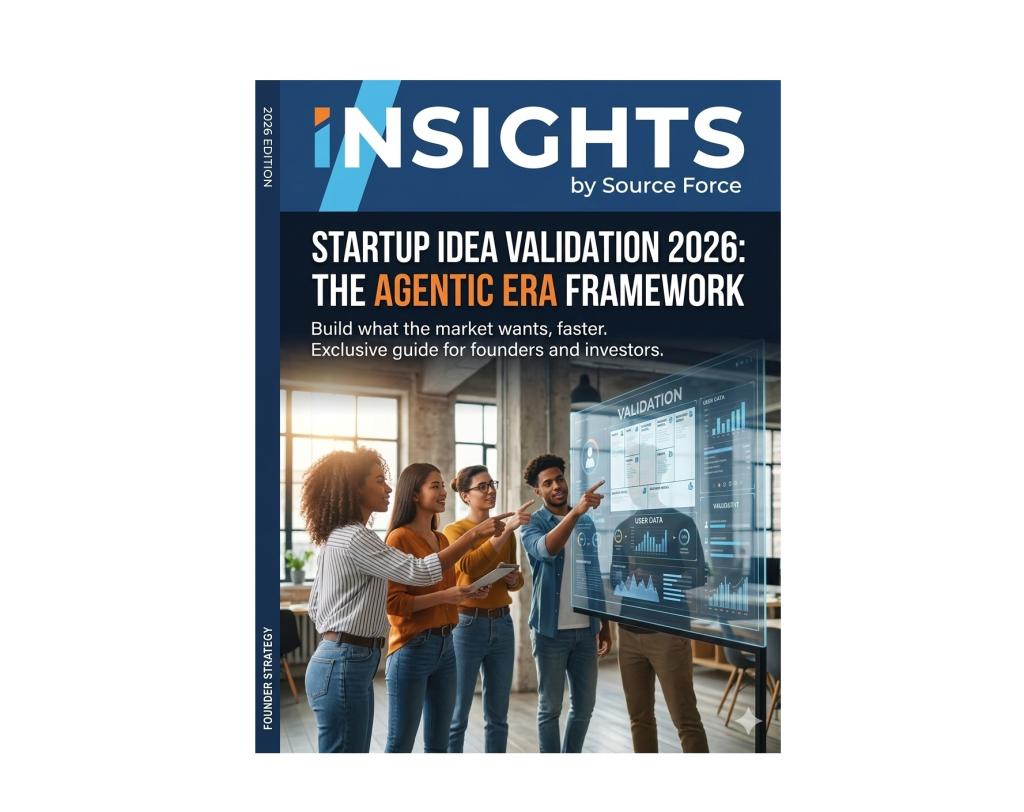
"An exhaustive 2026 report by Insights by Source Force on startup idea validation. Move past MVP 1.0; adopt the 90-day 'Validation Sprint' using Agentic AI workflows to confirm deep vertical pain and secure commitment. Learn to de-risk your runway with human-centric evidence."
Startup Idea Validation 2026: The Definitive Framework for the Agentic Era
The Agentic Era: Why "Fail Fast" is Dead and "Validate Faster" is the Only Rule That Matters
By The Editors of Insights by Source Force
Published in Industry Today | The Special Report on Venture Creation
It is a paradox of our time. We stand at the apex of technological leverage, where a single founder with a laptop and a subscription to Cursor can generate more code in a week than a team of ten could in a quarter just five years ago. AI-assisted engineering is, by most accounts, 30 times faster than it was in 2024. The barriers to entry have not just been lowered; they have been vaporized.
And yet, the graveyard of startups is fuller than ever.
Welcome to 2026. Welcome to the Agentic Era.
In this high-stakes environment, the mantra that defined a generation of Silicon Valley entrepreneurs has been officially retired. “Fail Fast” is dead. It has been replaced by a new, more demanding imperative: “Validate Faster.”
Because when the cost of building has plummeted to near zero, the true bottleneck for innovation is no longer technical. It is intellectual. It is existential. The critical question haunting every boardroom and garage founder alike is no longer "Can we build it?" but "Should we build it?"
For this Special Report, Insights by Source Force ventures deep into the modern frameworks of Idea Validation a discipline where the raw processing power of agentic workflows collides with the irreplaceable nuance of human-centric empathy.
The Validation Deficit: Why 90% Still Crash and Burn
Let’s confront the uncomfortable truth. Despite the technological surplus of the late 2020s the abundance of large language models, the accessibility of cloud compute, the sophistication of no-code tools the primary cause of startup death remains stubbornly, tragically consistent: No Market Need.
A comprehensive data analysis from Q1 2025 revealed a stark reality: 42% of failed ventures built a sophisticated solution for a problem that was either entirely non-existent or simply not painful enough for anyone to open their wallet. They built castles in the air, mistaking technological elegance for market demand.
This is the Validation Deficit. It’s the gap between what we can build and what we should build. Bridging this gap requires a ruthless, systematic approach to de-risking assumptions through evidence, not intuition. In 2026, this is not a one-and-done checklist, but a continuous process of discovery that unfolds across three critical "Viability Horizons."
Horizon I: Problem & Empathy Validation - The Search for "Deep Vertical Pain"
Before a single line of code is written, before a Figma mockup is designed, the founder must leave the building. In the age of AI, this mandate is more critical than ever. General problems are now solved by general models. If your idea addresses a surface-level inconvenience, OpenAI, Google, or Anthropic will absorb it into their next model update before your seed round closes.
To win, you must discover Deep Vertical Pain. You are looking for the sore spots so specific, so intricate, that they are invisible to the broad stroke of a general-purpose AI.
This begins with a new kind of competitive analysis: Benchmarking Against "Prompt-Ability." Sit down with Claude or GPT-4. Give it a simple, direct prompt describing the core problem you aim to solve. If the output is a passable, usable solution, your startup idea is not a company; it is a feature. It’s a prompt, not a product.
If you pass that test, the real work begins. Forget the "Mom Test." Welcome to the 5-Person Sanity Check. Do not fall into the trap of surveying 200 people for quantitative validation. In these embryonic stages, you need depth, not breadth. Find five individuals who fit your Ideal Customer Profile (ICP) with terrifying precision.
Sit with them. Watch them. Ask the most dangerous question of all: "Walk me through how you handle (Problem) right now."
If they look at you blankly, or describe a process of blissful ignorance, stop. You have identified a non-problem. But if they lean in, if their shoulders tense, if they begin to describe a messy, frustrating, "jury-rigged" system of spreadsheets, sticky notes, and duct-taped software a Rube Goldberg machine of workarounds you have struck gold. You have found a pain gap.
For the quantitative-minded, a new tool has emerged: Simulated Persona Testing. Platforms now allow you to deploy agentic AI to simulate 1,000 "Synthetic Personas" based on historical market data and demographic profiles. While these agents can never replace the raw, emotional feedback of a human conversation, they provide a powerful "stress test" for your value proposition in a matter of hours, revealing potential objections and usage patterns you might have missed.
Horizon II: Solution & Interest Validation - The Rise of the Interactive Value Magnet
So, you’ve confirmed the pain is real. It’s visceral. Now you must validate that your specific solution is the one they want. The era of the static landing page and the "Coming Soon" teaser is over. Users are fatigued by hype. They demand a taste.
Welcome to the world of Interactive Value Magnets and the Smoke Test 2.0.
Instead of a "Join Waitlist" button, you offer a "Free Diagnostic Agent." This is a purpose-built, single-feature AI tool that provides immediate value while simultaneously validating your core thesis.
Imagine your startup idea is an AI supply chain optimizer. You don't ask users to sign up for a beta. You build a tiny agent, launch it with a simple ad campaign, and invite logistics managers to "Input your supply chain data; our agent will find 3 hidden leaks in under 60 seconds." In that single interaction, you are not just collecting an email. You are:
This is a direct evolution of the Concierge MVP. The principle is ancient, but its application is newly relevant. Before automating a task, do it manually. If you plan to build an AI bookkeeper, offer to do a business’s books for them by hand for a month for free. If a customer won't let you solve their problem manually with all the inefficiency that entails they will never pay for the automated version. The Concierge MVP is the ultimate test of desire. It proves that the problem is painful enough to warrant any solution, even a clumsy human one.
Horizon III: Commitment & "Skin in the Game" - Where the Rubber Meets the Road
In the frothy waters of startup validation, "interest" is a mirage. The only true validation is Commitment. In the current economic climate, "Attention" has been devalued into a secondary currency. It is plentiful and cheap. The primary currency, the only one that matters, is Transaction.
It is vital to learn how to read the signal strength of your validation data.
The 2026 Validation Stack: Reaching "Validation-Speed"
The old playbook of six-month private betas, lengthy customer discovery cycles, and feature-bloated MVPs is a death sentence. The modern founder operates with a high-velocity stack designed to achieve "Validation-Speed."
Future Outlook: The Rise of "Agentic Viability"
As we look toward 2030, the goalposts are shifting once more. Validation will no longer be a purely human-centric exercise. We are entering an era where your startup’s first and most important customer may not be a person at all.
It will be an agent.
The next frontier is Interoperability and Agentic Viability. A startup idea won't just need to be useful to a human; it will need to be "Agent-Friendly." Your customers will have autonomous personal agents that navigate the web on their behalf, negotiating prices, booking travel, and managing subscriptions. If your tool’s API is poorly documented, if its pricing is opaque to a machine, if its user interface cannot be easily parsed and navigated by an autonomous AI, your product will be functionally invisible to the market. By 2030, passing the "Agent Turing Test" being discoverable and usable by AI will be a prerequisite for launch.
Conclusion
Idea validation in the 2020s is fundamentally about preserving your most valuable, non-renewable asset: Time. In the transition from the "Chatbot Era" to the "Agentic Era," the competition is not just other startups; it is the accelerating pace of technological change itself. The barrier to entry is gone, which means the barrier to failure has never been lower.
Founders who skip validation, who fall in love with their solution before proving the problem, are not merely taking a calculated risk. They are gambling with their runway, their team’s morale, and their vision in a house that is mathematically engineered to always win. In the Agentic Era, the only hedge against obsolescence is the unshakeable, evidence-backed certainty that what you are building is not just possible, but profoundly necessary. Validate faster, or fail for good.
DISCLAIMER: The views and opinions expressed in this article are those of the author and do not necessarily reflect the official policy or position of Industry Today. The information provided is for general informational purposes only and should not be construed as professional investment or business advice.

Operational Intelligence and ROI: The Modern Framework for Software Investment Analysis
From public listings to strategic buyouts, this piece examines how investors align capital with exit opportunities balancing risk, timing, and return potential to maximize outcomes.
Startup valuation is not always grounded in fundamentals. This article explores how capital flows, narrative-driven investing, and competitive deal-making create overvaluation and what it means for investors and founders.