The Intelligence Economy: How Organizations Measure the True Value of Software Investments
Operational Intelligence and ROI: The Modern Framework for Software Investment Analysis


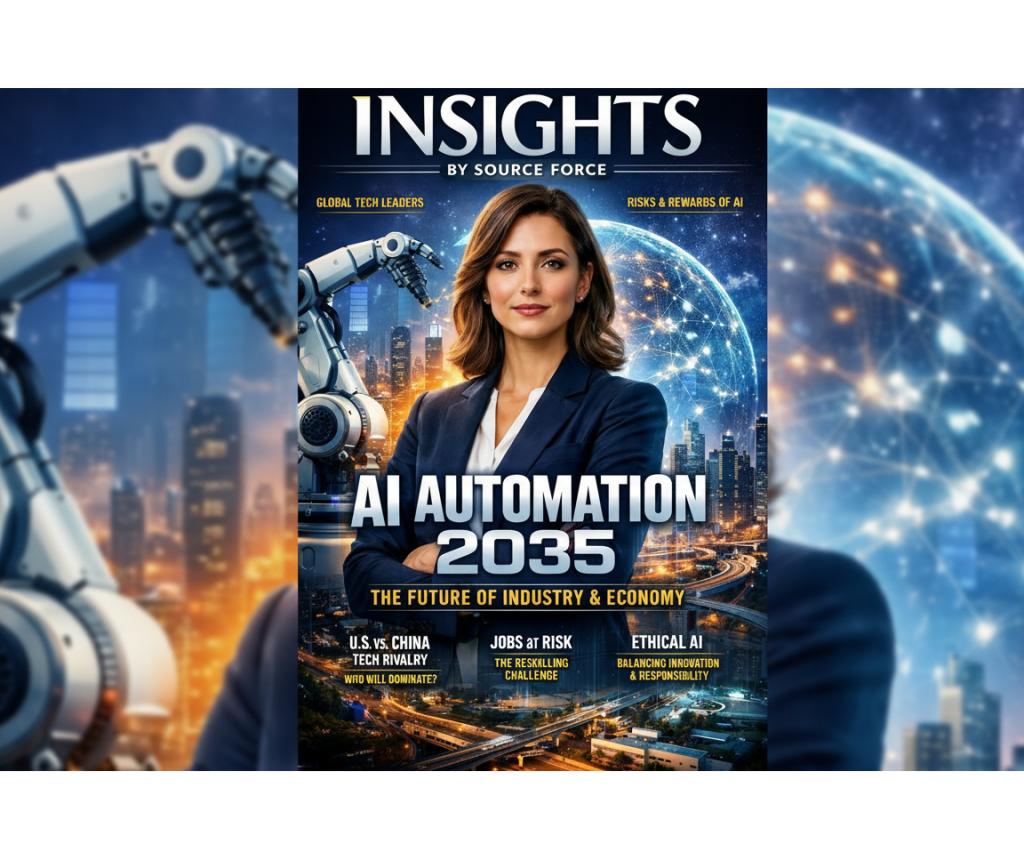
By 2035, AI automation will redefine economies. This article explores global strategies, key players, risks, and the future of industry transformation.
Editorial Desk - Insights by Source Force
In recent years, artificial intelligence (AI) has moved from being a futuristic concept to a transformative force reshaping industries across the globe. Automation powered by AI is not simply about replacing repetitive tasks; it is about reimagining how businesses operate, innovate, and compete. From manufacturing floors to financial institutions, healthcare systems to logistics networks, AI-driven automation is creating efficiencies that were once unimaginable. Yet, alongside this revolution lies a complex web of risks and challenges that demand careful consideration.
The potential of AI automation in industry is vast. In manufacturing, smart robotics and predictive analytics are streamlining production lines, reducing downtime, and enhancing product quality. In finance, AI algorithms are analyzing market trends in real time, enabling faster and more accurate decision-making. Healthcare is witnessing breakthroughs where AI systems assist in diagnostics, drug discovery, and patient monitoring, promising better outcomes and reduced costs. Even in agriculture, AI-powered drones and sensors are optimizing crop yields and resource management. These examples highlight how automation is not just about efficiency, it is about unlocking new possibilities and reshaping entire sectors.
However, the revolution is not without risks. One of the most pressing concerns is the displacement of human labor. As machines take over tasks once performed by people, questions about employment, skill gaps, and economic inequality become unavoidable. There is also the issue of trust: AI systems, while powerful, are not infallible. Bias in algorithms, data privacy breaches, and the lack of transparency in decision-making processes can undermine confidence in automation. Moreover, industries that adopt AI too quickly without proper safeguards may expose themselves to vulnerabilities, including cybersecurity threats and ethical dilemmas around accountability.
Despite these risks, the potential of AI automation remains undeniable. The key lies in striking a balance between innovation and responsibility. Industries must invest not only in technology but also in human capital, ensuring that workers are reskilled and empowered to thrive in an AI-driven environment. Policymakers and business leaders must collaborate to establish ethical frameworks and regulatory standards that guide the deployment of AI in ways that benefit society as a whole. If approached thoughtfully, AI automation can be a catalyst for inclusive growth, sustainability, and resilience in the face of global challenges.
Artificial intelligence (AI) automation is no longer a distant promise it is the engine driving a new industrial revolution. Across manufacturing, healthcare, finance, logistics, and agriculture, AI-powered systems are reshaping workflows, accelerating innovation, and redefining competitiveness. By 2035, analysts project the global AI automation market to exceed USD 5 trillion, a staggering leap from today’s figures. This transformation is not just about efficiency; it is about reimagining how economies function and how societies adapt to technological disruption.
The United States remains the epicenter of AI innovation, with Google, Microsoft, Amazon, and IBMleading the charge. AI automation is deeply embedded in healthcare diagnostics, financial trading, and defense systems. By 2035, the U.S. economy is expected to gain trillions in productivity, but risks loom large. Job displacement in manufacturing and services could widen inequality, while regulatory debates over algorithmic bias and privacy will intensify. The challenge for America will be balancing its innovation edge with ethical governance.
China’s AI revolution is propelled by aggressive state-backed strategies. Giants like Baidu, Tencent, and Alibaba are spearheading automation in logistics, smart cities, and surveillance technologies. By 2035, China is projected to rival the U.S. in AI market share, contributing massively to GDP growth. Yet, concerns over privacy, authoritarian use of AI, and geopolitical rivalry with the West cast long shadows. The country’s model of centralized AI deployment may deliver rapid gains but risks global fragmentation of standards.
The European Union is carving a distinct path, emphasizing ethical AI frameworks and sustainability. Companies such as Siemens and SAP are advancing industrial automation while aligning with strict regulatory standards. Europe’s cautious approach may slow adoption compared to the U.S. and China, but it positions the region as a leader in responsible AI. By 2035, Europe’s AI economy will be robust, though the risk of lagging behind in global competitiveness remains if regulation stifles innovation.
Japan and South Korea are leveraging their strengths in robotics and automotive industries. Companies like Sony, SoftBank, and Samsung are pioneering AI-driven robotics, autonomous vehicles, and consumer electronics. By 2035, these nations will remain export-driven AI economies, though aging populations may limit adaptability. Their reliance on global supply chains also exposes them to geopolitical risks.
Countries like the UAE and Saudi Arabia are investing heavily in AI as part of national diversification strategies. Smart cities, oil sector automation, and defense applications are central to their plans. By 2035, AI is projected to contribute USD 320 billion to regional GDP. Yet, overdependence on imported technology and cybersecurity vulnerabilities remain pressing concerns.
| Country/Region | Key Developments | Economic Outlook | Risks |
|---|---|---|---|
| United States | Heavy investment in AI R&D by tech giants (Google, Microsoft, Amazon). Strong focus on healthcare, finance, and defense automation. | Expected to remain global leader, contributing trillions to GDP growth. | Job displacement in manufacturing and service sectors; regulatory challenges. |
| China | Aggressive state-backed AI strategy; Baidu, Tencent, Alibaba leading in smart cities, logistics, and surveillance tech. | Projected to rival US in AI market share by 2035. | Concerns over privacy, authoritarian use of AI, and global tech rivalry. |
| European Union | Emphasis on ethical AI and regulation; Siemens and SAP driving industrial automation. | Balanced growth with strong focus on sustainability and green AI. | Slower adoption due to strict regulations; risk of lagging behind US/China. |
| Japan & South Korea | Robotics and automotive automation; Sony, SoftBank, and Samsung at the forefront. | Strong export-driven AI economy. | Aging workforce may limit adaptability; reliance on global supply chains. |
| Middle East (UAE, Saudi Arabia) | National AI strategies focusing on smart cities, oil diversification, and defense. | AI projected to contribute USD 320 billion to regional GDP by 2035. | Risk of overdependence on imported tech; cybersecurity vulnerabilities. |
Job Displacement: Millions of routine jobs could vanish, requiring unprecedented reskilling programs.
Cybersecurity Threats: AI systems are vulnerable to hacking, deepfakes, and data manipulation.
Ethical Concerns: Bias in algorithms, misuse in surveillance, and opaque decision-making processes.
Geopolitical Rivalry: U.S.-China competition may fragment global AI standards, creating instability.
Market Size: The global AI automation market is expected to grow from USD 273.6 billion today to USD 5.26 trillion by 2035, with a CAGR of over 30%.
Drivers: Rising demand for intelligent process automation, real-time decision-making, and scalable workflow management.
Key Players: IBM, Microsoft, Google, Amazon, Baidu, Tencent, and SAP are leading innovation, while startups in robotics, predictive analytics, and generative AI are disrupting traditional models.
By 2035, AI automation will not only redefine industries but also reshape economies and societies. Nations that invest in education, ethical governance, and infrastructure will thrive, while those that ignore risks may face widening inequality and instability. The revolution is inevitablebut its outcomes depend on how countries balance innovation with responsibility.
For Insights by Source Force, the story of AI automation is clear: it is both a promise and a peril. The next decade will determine whether this revolution becomes a force for inclusive growth or a catalyst for division.
Job Displacement: Millions of routine jobs could be automated, requiring massive reskilling programs.
Cybersecurity Threats: AI systems are vulnerable to hacking, deepfakes, and data manipulation.
Ethical Concerns: Bias in algorithms, surveillance misuse, and lack of transparency in decision-making.
Geopolitical Rivalry: US-China competition may fragment global AI standards, creating trade and security risks.
Ultimately, the story of AI automation is one of transformation. It is a revolution that promises to redefine industries, but it also compels us to confront difficult questions about the future of work, fairness, and responsibility. The risks are real, but so too is the potential for progress. For industries willing to embrace change with foresight and care, AI automation offers not just a technological upgrade, but a profound opportunity to shape a better future.
AI automation is not just a technological upgrade it is a global revolution. By 2035, industries across continents will be transformed, economies will be reshaped, and societies will face both unprecedented opportunities and profound challenges. The United States and China will continue to dominate, Europe will lead in ethical frameworks, India will rise as a cost-effective powerhouse, and Japan, South Korea, and the Middle East will carve unique paths. Yet, risks around job displacement, cybersecurity, and geopolitical rivalry remain pressing. The future of AI automation will depend on how nations balance innovation with responsibility, ensuring that this revolution becomes a force for inclusive growth rather than division.
The views and projections expressed in this article are based on current industry research, expert analysis, and market forecasts. They are intended for informational purposes only and do not constitute financial, investment, or policy advice. Insights by Source Force Magazine is committed to providing balanced perspectives on emerging technologies. Readers are encouraged to consult multiple sources and professional guidance before making decisions related to AI automation and industry transformation.

Operational Intelligence and ROI: The Modern Framework for Software Investment Analysis
From public listings to strategic buyouts, this piece examines how investors align capital with exit opportunities balancing risk, timing, and return potential to maximize outcomes.
"A strategic report on the 2026-2030 Big Data outlook. Key topics include Agentic Analytics, Multimodal Embedding for Dark Data, and Zero-Knowledge Discovery. Essential reading for CEOs transitioning to agent-ready enterprise architectures."