The Intelligence Economy: How Organizations Measure the True Value of Software Investments
Operational Intelligence and ROI: The Modern Framework for Software Investment Analysis

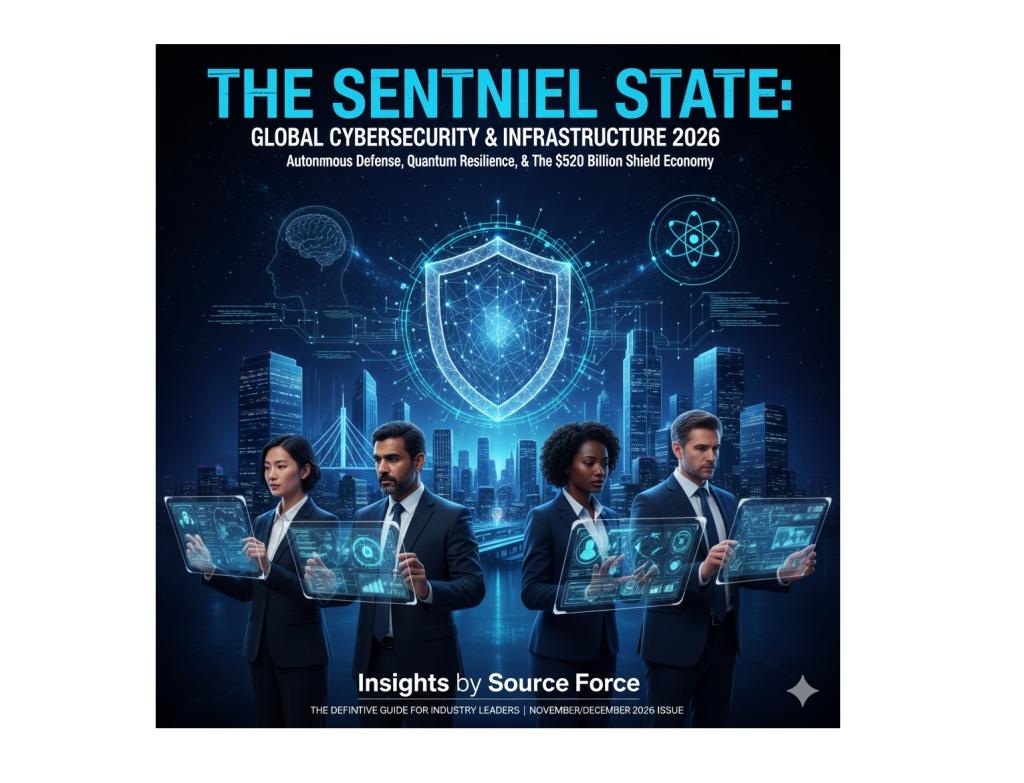
A 2026 deep-dive into the $520B cybersecurity market. Insights on Messenger2050 Technologies, AI-driven infrastructure, and the rise of Quantum-Resistant Defense.
The Sentinel State: Global Cybersecurity & Infrastructure 2026
Source Force Editorial Team
In 2026, the global economy does not just run on data it lives or dies by its resilience. As we move into an era of "Sentient Infrastructure," where cities, power grids, and logistics networks are governed by autonomous AI, the traditional concepts of firewalls and antivirus have become relics. Today, cybersecurity is the backbone of national sovereignty and the primary protector of global GDP.
Industry Size and Growth: The $520 Billion Economy
The cybersecurity industry has witnessed a tectonic shift. Total global spending on security products and services is projected to exceed USD 520 billion by the end of 2026, doubling the 2021 figures.
Key Players and Global Corporate Giants
The 2026 market is divided between legacy giants and "Next-Gen" infrastructure architects.
The Big Four Security Leaders
Growing Infrastructure Innovators
Technology in Detail: Features and Modern Uses
Modern cybersecurity in 2026 is defined by Autonomous Defense and Identity Sovereignty.
Key Features of 2026 Tech
Strategic Uses
Country - by-Country Market Deep Dive
Region | 2026 Market Status | Key Infrastructure Priority |
|---|---|---|
USA | $210B Market Share | Zero Trust: Implementing the "Federal Zero Trust Strategy" across all 16 critical infrastructure sectors. |
China | $45B Market Share | Digital Sovereignty: Prioritizing "Hard-Tech" security and domestic semiconductor encryption standards. |
UAE & Qatar | Rapid Expansion | Smart City Resilience: Leading the world in AI-governed urban security and autonomous grid protection. |
Singapore | Fintech Shield | Cross-Border Security: Securing the digital payment gateways for the entire APAC region. |
Japan & S. Korea | OT Convergence | Manufacturing Security: Protecting high-tech factories from industrial espionage and ransomware. |
Turkey | Regional Hub | Digital Communications: Developing secure, localized infrastructure to bridge Europe and the Middle East. |
The Future: 2026 to 2030
As we look beyond 2026, the focus shifts to Cyber-Resilience. The industry's goal is no longer just "protection" (preventing attacks) but "resilience" (ensuring the system keeps running during an attack). By 2030, we expect the emergence of Self-Healing Infrastructure networks that can automatically isolate breached segments and regenerate themselves without human input.
Disclaimer: Information in this report is derived from 2026 forecasts by Cybersecurity Ventures, the World Economic Forum, and proprietary market data. The mention of specific companies, including Messenger2050 Technologies, is for informational purposes only. Security markets are highly volatile; past performance is not indicative of future results.

Operational Intelligence and ROI: The Modern Framework for Software Investment Analysis
A definitive report for Insights by Source Force on the 1,600+ global unicorns. Detailed country-by-country analysis, future outlooks to 2030, and the impact of Agentic AI on startup valuations.
Global Tech Regulation 2026, EU AI Act Enforcement, China AI Ethics Law, UAE Data Privacy, Social Media Age Verification Australia.